
You need more space. Maybe it’s for vehicles, equipment, a workshop, or just storage that’s currently taking over your basement. The question isn’t whether to build, it’s what to build.
Pole barns and garages both solve the same basic problem, but they do it in very different ways. The right choice depends on your property, your budget, and what you actually plan to do with the space. Here’s how to figure out which one makes sense for you.
What’s the Actual Difference?
Let’s clear up the basics first, because a lot of people use these terms interchangeably when they’re actually describing different structures.
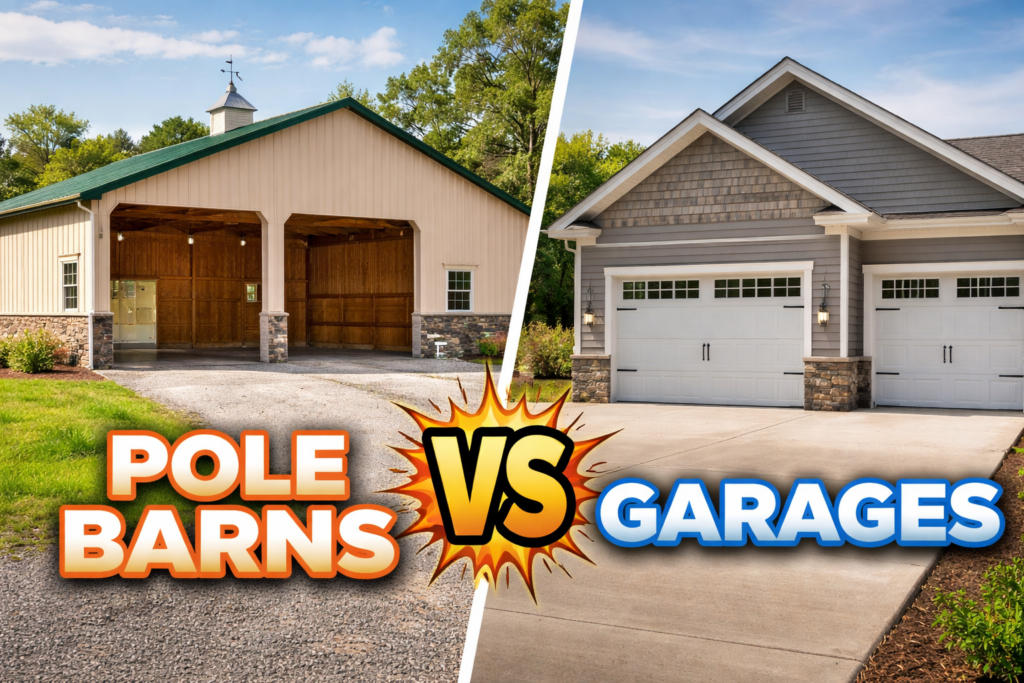
A traditional garage uses a continuous concrete foundation with wood or block walls built on top. The foundation bears the weight of the structure. It’s the same construction method used for most homes.
A pole barn (also called post-frame construction) uses large poles or posts buried directly in the ground or anchored to concrete piers. The posts bear the structural load, which means you don’t need a continuous foundation. The walls are essentially just infill between the posts.
This fundamental difference in how the building stands up affects everything else: cost, timeline, flexibility, and what you can do with the space.
The Cost Breakdown
Money talks, so let’s start there.
Pole barn costs:
- $15-$35 per square foot for basic structures
- A 30×40 pole barn (1,200 sq ft) typically runs $20,000-$45,000
- Concrete slab floor adds $5-$8 per square foot if desired
- Minimal site prep required in most cases
Traditional garage costs:
- $35-$70 per square foot, depending on finishes
- A 24×24 garage (576 sq ft) typically runs $25,000-$50,000
- Foundation costs are built into the price
- More extensive site prep and excavation needed
The math is pretty clear: pole barns give you roughly twice the square footage for the same money. That’s why farmers and rural property owners have been building them for decades.
But cost per square foot doesn’t tell the whole story.
When a Pole Barn Makes More Sense
Pole barns shine in specific situations. If any of these describe your needs, you’re probably looking at post-frame construction:
You need a lot of space. If you’re storing tractors, RVs, boats, or multiple vehicles, pole barns deliver maximum square footage for minimum cost. A 40×60 pole barn gives you 2,400 square feet; try pricing that as a traditional garage.
Your property is rural or agricultural. Pole barns fit the aesthetic of farm properties and rural lots. They’re also easier to permit in agricultural zones where building codes may be less restrictive.
You want flexibility. The post-frame design creates wide-open interior space without load-bearing walls. You can configure the interior however you want, and reconfigure it later without structural concerns.
Speed matters. Pole barns go up fast. A basic structure can be completed in days rather than weeks. Less foundation work, fewer materials, simpler construction sequence.
The ground is challenging. On sloped sites or areas with difficult soil conditions, pole barns adapt more easily than structures requiring continuous foundations.
Contractors like Vetter Construction, who specialize in post-frame buildings, can often complete projects in a fraction of the time traditional construction requires.
When a Traditional Garage Makes More Sense
Garages have their own advantages that matter in certain situations:
You’re in a suburban neighborhood. HOAs and municipal codes often restrict or prohibit pole barn-style construction in residential areas. A traditional garage matches the neighborhood aesthetic and typically sails through permitting.
The space will be climate-controlled. If you’re planning to heat or cool the space year-round, traditional construction with insulated walls and a finished interior is more energy-efficient. Pole barns can be insulated, but it’s an additional step and cost.
You want living space above. Building a second story or bonus room above a garage is straightforward with traditional construction. It’s possible with pole barns, but it requires additional engineering.
Resale value is a priority. In suburban markets, a traditional attached or detached garage adds more to home value than a pole barn. Buyers expect garages; pole barns can be a harder sell, depending on the neighborhood.
The structure attaches to your home. If you’re adding an attached garage, traditional construction ensures that it matches your home’s existing structure and ties into it properly.
Speaking of value, certain home renovation projects add significant value to your property. Where your outbuilding falls on that spectrum depends largely on your local market and how the structure fits the property.
The Hybrid Option: Finished Pole Barns
Here’s where things get interesting. Modern pole barns aren’t just metal-sided agricultural buildings anymore.
Post-frame construction has evolved to include:
- Insulated walls and ceilings
- Finished interiors with drywall
- Residential-style siding and roofing
- Concrete floors with radiant heat
- Full electrical and plumbing
- Windows, entry doors, and overhead doors matching residential styles
These “shouses” (shop-houses) or “barndominiums” blur the line between pole barn and traditional construction. You get the cost efficiency and speed of post-frame with the finished appearance of a conventional building.
For property owners who want workshop or garage space but also need the building to look appropriate for a residential setting, this middle ground often hits the sweet spot.
Practical Considerations Before You Decide
Beyond cost and construction type, think through these factors:
Permits and codes. Check with your local building department before committing to either option. Some jurisdictions have size limits on accessory structures, setback requirements, or restrictions on pole barn construction in residential zones.
Utilities. Will you need electrical service? Plumbing? The further you are from your main panel or water supply, the more this adds to the cost, regardless of the building type.
Access. Consider how vehicles and equipment will get in and out. Door placement, driveway access, and turning radius all matter, especially for larger equipment.
Future needs. Building a little bigger than you think you need almost always pays off. Expanding later costs significantly more than building larger initially.
Contractor availability. Not all builders do both types of construction. Pole barn specialists and traditional garage contractors often work in different markets. Get quotes from contractors experienced in the specific type you’re considering.
Making the Final Call
Here’s the simple framework:
Build a pole barn if:
- Budget is a primary concern
- You need maximum space
- The property is rural or agricultural
- You want the project done quickly
- Interior finish isn’t a priority (or you’ll finish it yourself over time)
Build a traditional garage if:
- You’re in a suburban neighborhood with HOA restrictions
- The structure attaches to your home
- Climate control and finished interior matter from day one
- Resale value in your market favors traditional construction
- You’re building up (second story or bonus room)
Consider a finished pole barn if:
- You want the cost efficiency of post-frame
- But need it to look residential
- And your local codes allow it
There’s no universally “better” option. The right choice matches your property, your budget, and your actual needs, not what worked for your neighbor or what a contractor wants to sell you.
Getting Started
Whichever direction you’re leaning, start with a site visit from a qualified contractor. They can assess your property, discuss permit requirements, and provide accurate pricing for your specific situation.
Get at least three quotes, and make sure you’re comparing apples to apples, same size, same features, same level of finish. The lowest bid isn’t always the best value if it’s missing things the others include.
Your outbuilding will be part of your property for decades. Take the time to make the right choice upfront, and you’ll have functional space that serves you well for years to come.
More Stories
How Prefabrication Is Changing the Construction Industry
Leading Kitchen Remodeling Experts – Trusted Contractors for Modern Home Upgrades
How to Choose the Right Contractor for Home Renovation