
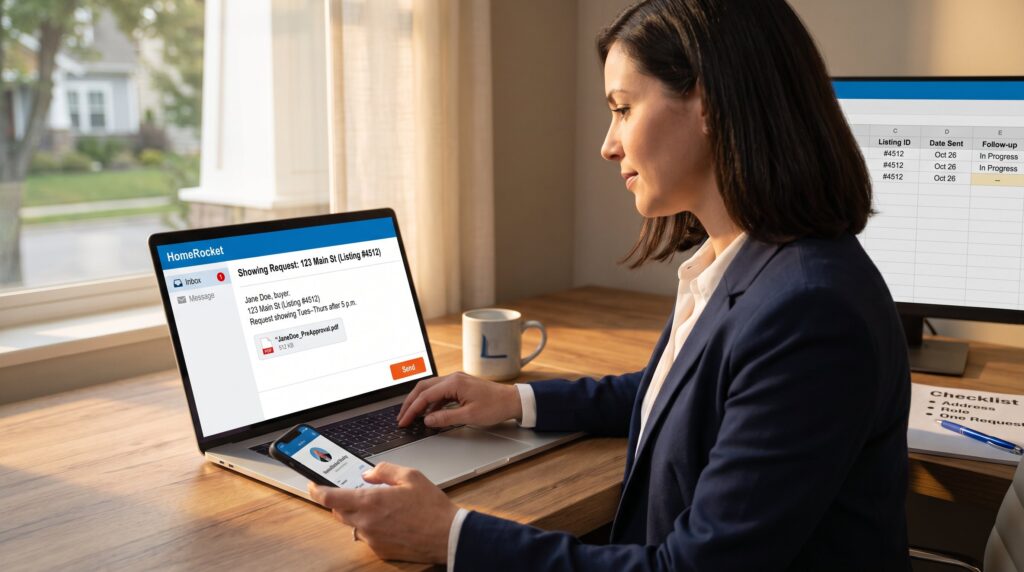
How to Email HomeRocket Realty About a Property Listing starts with being precise and short. The sender gathers the property address or listing ID, a brief status (buyer, seller, tenant), and a clear single request before typing. In 25 words the message should state who they are, which property they mean, and what they want: showing, price info, or next steps. This introduction explains what to gather, how to write the message, and how to follow up so HomeRocket Realty can respond quickly and accurately.
Key Takeaways
- When emailing HomeRocket Realty about a property listing, always include the exact property address or listing ID to avoid confusion and delays.
- Keep your email concise—state your name, role, and a single clear request such as scheduling a showing or asking for price details within 25 words.
- Use a specific and brief subject line under 50 characters that clearly references the property and your request.
- Attach only essential documents like a single PDF pre-approval letter when making an offer, avoiding multiple or large files that may trigger spam filters.
- Follow up politely after 2–4 days if you receive no response, logging all communications to track progress efficiently.
- Avoid common mistakes like vague subject lines, lengthy messages with multiple requests, or omitting important property identifiers to ensure a prompt reply.
Prepare Before You Write: What To Gather And Why
Start with the fact: collect exact identifiers and contact details first.
Why it matters: agents handle many listings. A single wrong digit in an address or a missing listing ID can delay a reply by days. Gather these items before composing an email:
- Exact property address or listing ID. This is the single clearest way to avoid confusion.
- Full name and best phone number. State preferred contact times (e.g., “after 4 p.m. weekdays”).
- Role and intent: buyer, seller, tenant, investor. Add core criteria like budget, move‑in window, bedrooms, and neighborhoods.
- Purpose and one clear request: showing, pricing clarification, disclosures, HOA fees, or offer instructions.
- Financial proof if making an offer: pre‑approval or proof of funds. Attach these only if asking about submitting an offer.
Practical example: “Jane Doe, buyer. 123 Main St (Listing #4512). Request showing Tues–Thurs after 5 p.m. Pre‑approval attached.” That short checklist reduces back‑and‑forth and speeds a decision.
Tip on files: avoid heavy or multiple attachments on a first contact. A single PDF (pre‑approval or proof of funds under 1 MB) is fine when the email is about an offer. Use clear filenames, e.g., “JaneDoe_PreApproval.pdf.”
Related resources and contact protocols live in the company contact guide for reference. For details on official addresses and response options, consult the centralized contact reference in the contact guide.
Crafting The Perfect Email: Subject, Body, And Attachments
Fact first: an effective email is three parts, a precise subject, a focused body under 150 words, and only necessary attachments.
Subject line rules: keep it under ~50 characters and specific. Examples that work:
- “Inquiry about 123 Main St, showing request”
- “Offer question, 2BR condo on Oak Ave (ID 4512)”
Open the body with a one‑sentence intro: state name, role, and main request. Example opener: “Hello, Jane Doe here, pre‑approved buyer. I’m requesting a showing for 123 Main St this week.” Place the listing identifier immediately after the opener.
Body structure (150 words or less):
- One‑line introduction with contact times.
- One sentence identifying the listing (address or ID) and the main request.
- Two or three targeted questions (price flexibility, recent upgrades, HOA fees, disclosure packets, showing windows).
- Clear call to action: “Please confirm available viewing times this week.”
Attachments: send only what matters. For a showing request, no attachments. For an offer, attach a concise pre‑approval or proof of funds PDF (labeled with the sender’s name). Avoid sending multiple images or large files up front, as they can trigger spam filters.
Tone and cadence: remain professional and direct. Use bullets if listing multiple questions. That makes it easy for the agent or customer‑service rep to scan and reply. For examples of what to include in an email, see the focused checklist in the what to include page.
Follow‑Up, Tracking, And Common Pitfalls To Avoid
Core insight first: a polite, timed follow‑up often gets the response: chasing too fast damages credibility.
Follow‑up timing: if no reply, wait 2–4 days for the first nudge. Send a second follow‑up 1–2 weeks later. Stop after 3–4 attempts unless the agent responded with a longer timeframe. Keep follow‑ups short and reference the original email and listing ID.
Tracking method: log every sent message and reply timestamp in a simple spreadsheet or CRM. Track fields: date sent, recipient, listing ID, subject, follow‑up dates, and outcome. This captures promised showing times, counteroffers, and commitments.
Common mistakes to avoid:
- Vague subject lines that bury the property in general language.
- Leaving out the listing identifier or wrong address.
- Overlong messages with multiple unrelated requests.
- Sending unsolicited large attachments that get blocked by filters.
- Using informal SMS‑style shorthand in email bodies.
Real example of a failure: one renter sent a 400‑word narrative about lifestyle and budget without an address: agents didn’t recognize the target and the request sat unanswered for five days. Lesson learned: lead with the property, then add context.
If an email bounces, check the official contact routing to confirm the right address. HomeRocket maintains guidance on how to find the correct contact page: use the streamlined steps in the contact page finder to verify addresses.
Pro tip: when the transaction is time‑sensitive (an offer window or deadline), state that deadline in the first sentence and attach only essential documents to speed deliverability.
Conclusion
A short, well‑structured message saves days of back‑and‑forth. Gather the listing ID, state who they are and one clear request, use a precise subject, and attach only relevant proof when needed. Follow up politely on a set schedule and log replies. These steps help HomeRocket Realty respond faster and reduce errors in negotiations.
More Stories
How to Avoid Fake HomeRocket Realty Contact Details
Other Ways to Contact HomeRocket Realty
What is a slat wall panel? A WoodUpp slat wall panel is oak lamellas on acoustic felt that quiets a room
How to Request a Showing by Email