
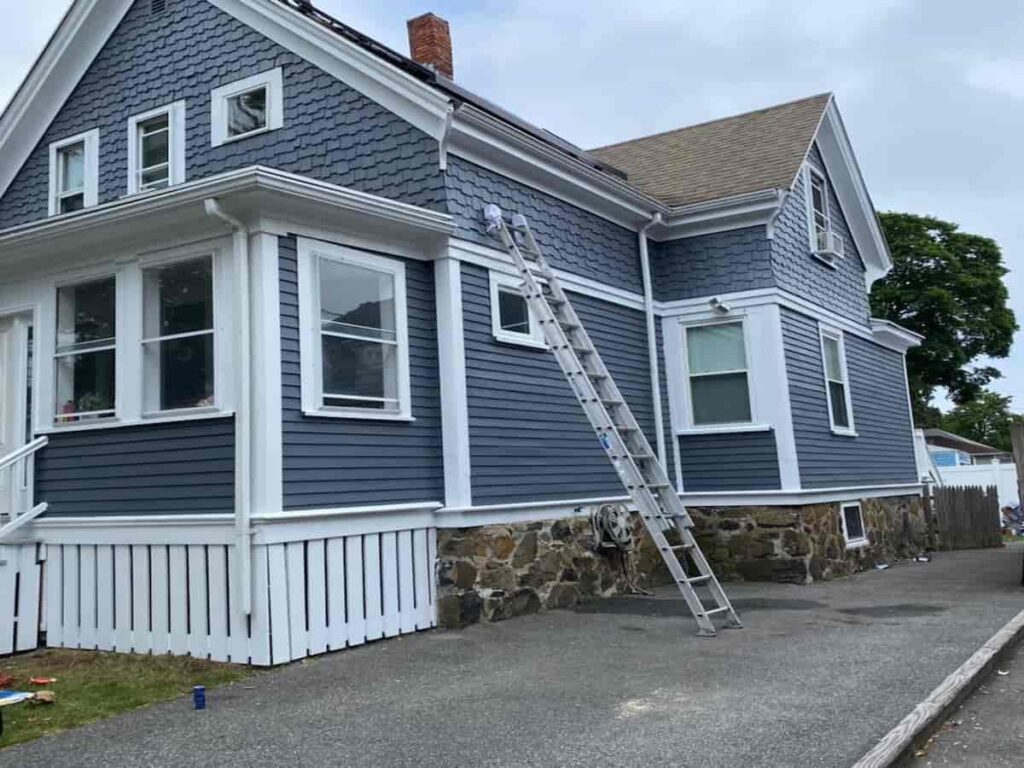
Exterior painting is one of the most impactful home improvement projects you can undertake, and one of the easiest to get wrong.
Not dramatically wrong, in most cases. The mistakes that cost homeowners the most money are rarely obvious at first. They hide beneath a fresh coat of colour, looking perfectly fine for six months or a year before the peeling starts, the caulking pulls away, and the wood underneath begins to show the consequences of what was skipped or rushed.
The frustrating part is that most of these mistakes are completely avoidable. They do not require specialized knowledge to prevent. They just require knowing what to watch for before the job starts, during the work, and when you are evaluating the finished result.
Here are the mistakes that come up most often and what you can do differently.
Exterior Painting Failures Almost Always Start With Bad Prep
Ask any professional who has been doing this work for more than a few years, and they will tell you the same thing: exterior painting failures almost always trace back to preparation, not product.
The paint itself rarely fails on its own. What fails is the bond between the paint and the surface beneath it, and that bond is only as strong as the condition of the surface when the coating was applied.
Homeowners and contractors alike underestimate how much time proper preparation takes. On a typical two-story home, thorough prep – washing, scraping, sanding, priming, caulking, and repairing damaged areas – should take at least one to two full days before any topcoat goes on. On homes with significant existing paint failure or wood damage, it can take longer.
When that preparation is rushed or skipped, the timeline gets shorter, and the price gets lower. But the lifespan of the job gets shorter too, often dramatically so.
The most commonly skipped preparation steps and what they cost:
Skipping thorough pressure washing. Paint applied over a dirty, mildew-contaminated, or oxidized surface has nothing solid to bond to. The new coating may look fine immediately after application, but adhesion is compromised from the start. Peeling typically shows up within one to two seasons, starting in the areas with the most contamination.
Painting over loose or unstable existing paint. Scraping is time-consuming and unglamorous. It is also non-negotiable. Running a new coat over peeling or flaking existing paint does not stabilize it, it adds weight to an already failing bond and accelerates the failure. The only correct approach is to scrape back every loose area to a stable edge before any new coating is applied.
Skipping primer on bare surfaces. Whenever scraping, sanding, or repairs expose bare wood or bare metal, primer needs to go on before the topcoat. Bare surfaces absorb paint at a different rate than painted surfaces, leading to uneven coverage and reduced adhesion in those areas. Primer seals the surface and gives the topcoat a consistent base to bond to.
Ignoring caulking. Caulking is the front line of defence against moisture infiltration, and failed caulking is one of the most common causes of exterior paint failure. Every joint around window frames, door casings, trim boards, and any penetration in the wall surface needs to be inspected and re-caulked where needed before painting begins. A small gap that looks minor can let in enough seasonal moisture to lift paint from behind within a single winter.
Choosing Paint Without Understanding What the Surface Needs
Walk into any paint store and you will find dozens of exterior formulations competing for your attention. The marketing language on most of them is nearly identical – durable, weather-resistant, long-lasting. Choosing between them based on that language alone is how homeowners end up with the wrong product for their situation.
The right paint for an exterior surface depends on several factors that have nothing to do with brand loyalty or price point.
Substrate type matters. Wood, fiber cement, stucco, brick, and metal each absorb and release moisture differently and require coatings formulated for their specific behavior. A paint that performs well on wood siding may not be the right choice on a stucco wall.
Climate matters. In regions with cold winters and warm summers, paint films go through hundreds of expansion and contraction cycles over the life of the coating. A film that is too rigid cracks under that stress. In high-humidity regions, moisture vapor transmission, how well the coating allows moisture to escape from the wall without lifting the paint, becomes a critical factor.
Sheen level matters more than most people realize. Higher sheen finishes, satin and semi-gloss, are more moisture-resistant and easier to clean but show surface imperfections more readily. Flat finishes hide texture variation better but are less durable in high-exposure areas. Choosing the sheen level based only on appearance preference without considering the performance implications leads to either maintenance problems or a finish that looks worse than expected.
The number of coats matters. One coat of topcoat is almost never sufficient on a full exterior repaint. Two coats build a film thick enough to resist moisture and UV breakdown over time. Quotes that include only one topcoat coat do not offer a discount; they offer a shorter lifespan.
Timing the Job Around Convenience Rather Than Conditions
One of the most underestimated factors in exterior painting is timing, and not just in terms of the season. The specific conditions during application affect how paint cures, how well it bonds, and ultimately how long it holds up.
Most professional-grade exterior coatings are formulated to be applied within a temperature range of roughly 10°C to 30°C (50°F to 86°F). Outside that range, the chemistry of film formation changes in ways that compromise the finished coating, even when it looks fine to the eye.
Painting in high heat causes the surface of the film to skin over before solvents beneath it can escape. Those trapped solvents create internal pressure that causes blistering, sometimes immediately, sometimes after the first warm day of the following season.
Painting too close to freezing prevents proper film formation. The coating may appear to dry, but it never develops full adhesion strength, and the first freeze-thaw cycle typically causes widespread failure.
Beyond temperature, conditions worth paying attention to include:
- Dew point. High ambient humidity, even on a warm, sunny day, can prevent proper adhesion if moisture is condensing on surfaces. Start times on high-dew-point days should be delayed until surfaces have fully dried.
- Rain forecasts. Exterior coatings need at least 48 hours without rain after application to cure properly. Painting ahead of a predicted rain system, even a light one, can wash uncured paint off the surface or cause widespread adhesion failure.
- Direct sun exposure. Applying paint to a surface in direct, intense afternoon sun accelerates dry time unevenly across the surface, causing lap marks and adhesion problems. Experienced crews follow the shade around the house throughout the day.
These environmental constraints are especially important in hotter climates like Texas, where exterior performance and construction considerations for rural homes such as barndominiums are closely tied to regional builders, including East Texas barndominium builders.
Hiring Based on Price Without Understanding What the Quote Includes
Price comparison is a reasonable starting point when evaluating contractors. It becomes a problem when it is the only comparison being made.
Two quotes for the same house can differ by thousands of dollars for reasons that have nothing to do with profit margin. They differ because different contractors are planning to do genuinely different amounts of work.
The lower quote may reflect:
- One coat of topcoat instead of two
- No primer on bare or repaired areas
- Minimal prep, a quick wash and straight to painting
- Builder-grade product instead of professional-grade coating
- No wood repairs or caulking included in scope
- A subcontracted crew that the company has never worked with before
None of those trade-offs will be obvious in the finished job on day one. They become obvious over the following seasons as the work fails faster than it should.
Before accepting any quote, ask specifically what it includes. Scope of preparation work, product brand and line, number of coats, warranty terms, and who will physically be doing the work are all questions with answers that belong in writing before you sign anything.
Skipping the Final Walkthrough
The final walkthrough is not a formality. It is your opportunity to review the finished work before the crew leaves and the job is considered closed.
Most homeowners either rush through it or skip it entirely out of a sense that it would be rude to look too carefully. That instinct costs them. Problems that are caught during the walkthrough get fixed on the spot. Problems discovered a week later require a callback, and some contractors are far less responsive after they have been paid in full.
What to check carefully during a final walkthrough:
- Even coverage with no thin spots, streaks, or areas that look visibly different from the surrounding surface
- Clean, precise lines where paint meets trim, window frames, doors, and foundation
- No overspray on glass, hardware, concrete, or landscaping
- Consistent sheen across all painted surfaces, patches that look duller or shinier than surrounding areas indicate uneven application or coverage
- Caulking that is smooth, fully adhered, and cleanly painted over at all joints
- No paint on surfaces that should not have been painted – deck boards, brick, roofing material
Take your time. Check the work from multiple angles and in direct sunlight, where thin coverage and uneven application are most visible. A professional crew that stands behind their work will address legitimate concerns without resistance. If a contractor pushes back on reasonable observations during a walkthrough, that tells you something important about what follow-up will look like if problems appear later.
What Good Exterior Painting Looks Like Years Later
The true measure of a quality exterior painting job is not how it looks the day the crew packs up. It is how it looks three, five, and eight years later.
A job done right – with thorough prep, appropriate products, correct application conditions, and two full coats of topcoat – should hold up for eight to twelve years in most climates before a full repaint is needed. High-wear areas like doors, south-facing walls, and trim around windows may benefit from touch-ups sooner, but the bulk of the work should remain sound.
Achieving that lifespan requires avoiding the shortcuts described above, not just from the crew you hire, but from yourself if you are involved in any part of the decision-making. Rushing the timeline, accepting a quote that seems too good, skipping the walkthrough, or choosing a contractor based on price alone are all decisions that shorten the life of the work, regardless of how good the product is.
Exterior painting is a genuine investment in your home’s protection and appearance. Treat it like one, and the results will show for years to come.
More Stories
Things to Do on the Southeast Coast of Florida
Developing a Spring On Your Own Land: What It Takes, and What It Costs
HomeRocketRealty.com: The Complete 2026 Guide To Finding, Buying, And Selling Homes Faster
Container Grades and What They Mean for Purchasers