
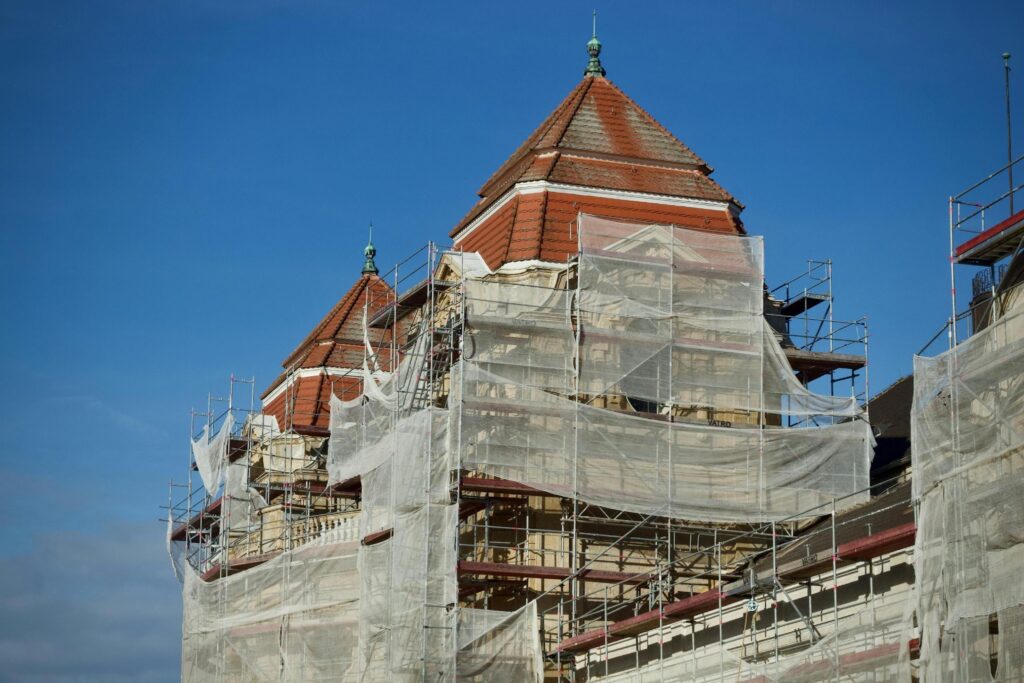
Modern construction demands systems that accelerate delivery without compromising worker safety. Modular facade scaffolding has become the dominant choice on large commercial and industrial projects because it combines rapid assembly with engineered structural reliability. For contractors under tight schedules and strict safety regimes, understanding the technical advantages of modular systems is a competitive necessity.
What makes a scaffold truly modular
A modular scaffold is built from standardised, prefabricated components that connect through engineered interfaces – rosettes, wedge locks or cup-and-wedge mechanisms. Every element is manufactured to tight tolerances, tested against norms such as EN 12810 and EN 12811, and designed to work seamlessly with the rest of the system. The result is a structure whose performance is predictable and verifiable across any project.
Assembly speed and project economics
On large-scale facade works, the time needed to erect and dismantle scaffolding often represents a significant share of the total schedule. Modular systems can reduce assembly time by 30 to 50 percent compared with traditional tube-and-coupler scaffolds. Fewer parts, pre-defined geometries and intuitive connections mean smaller crews cover more square metres per shift, translating directly into lower labour costs.
Structural safety through standardisation
Standardisation is the backbone of technical safety. Because every component has a known load capacity, geometry and failure mode, engineers can design scaffold configurations with complete confidence in their performance. This eliminates the variability of improvised solutions and reduces the risk of on-site errors compromising stability.
Certified modular systems come with detailed technical documentation, calculation sheets and standard configurations that accelerate approval by safety officers and inspectors. On international projects, this is often the difference between smooth handover and weeks of delay.
Load distribution and engineered stability
Modular facade scaffolds distribute loads uniformly across their structure. Vertical standards, horizontal ledgers and diagonal braces transfer forces to base plates and anchor points, minimising concentrated stresses. Load classes from 1 to 6 allow designers to match the scaffold exactly to the intended use – light facade works, heavy masonry, material storage or mixed applications.
Adaptability to complex facades
Contemporary architecture rarely presents flat, uniform facades. Curved elevations, setbacks, balconies and ornamental features demand flexible solutions. Modular systems respond with a wide range of component lengths, adjustable brackets, cantilever frames and bridging modules that allow the structure to follow the building geometry without compromising safety. This adaptability is particularly valuable on heritage restorations and landmark projects.
Component interchangeability and long-term value
A key practical advantage of a modular system is that every component is interchangeable across projects. A set of standards, ledgers and platforms purchased today can be deployed on a low-rise residential site next month and on a 40-metre industrial facade next year. This reusability dramatically improves return on investment and reduces inventory complexity for companies managing large scaffold fleets.
Workforce training and error reduction
Because modular systems rely on repeatable connection patterns, workforce training is faster and more effective. Teams that master the assembly sequence on one project carry that competence directly to the next, reducing the learning curve and lowering the risk of errors. Clear visual cues – colour-coded locks, engraved identifiers – further support correct installation under time pressure.
Sustainability and lifecycle performance
Hot-dip galvanised steel modular systems routinely deliver service lives exceeding twenty years with minimal maintenance. Damaged components can be replaced individually without scrapping the assembly, and end-of-life materials are fully recyclable. This durability and circularity aligns with sustainability requirements that now feature prominently in public tenders and ESG reporting.
Where to learn more
A detailed overview of certified modular facade scaffolding systems, their specifications and configuration examples is available at https://slv-group.eu/el/ – a useful reference for contractors planning large-scale projects.
Conclusion
Modular facade scaffolding represents the intersection of engineering precision and operational efficiency. Faster assembly, predictable structural performance, adaptability to complex geometries and long-term component value make it the rational choice for contractors committed to safe, on-time delivery. Investing in a certified modular system protects workers, strengthens project margins and positions the company for sustained growth.
More Stories
How All-Season Outdoor Rooms Are Changing What Homeowners Look for in a Property
What Makes Mobile Slot Games Feel Smooth and Easy to Use?
Change Your Living Spaces: Interior Design Hacks
Designing an Office Around How Your Business Operates