
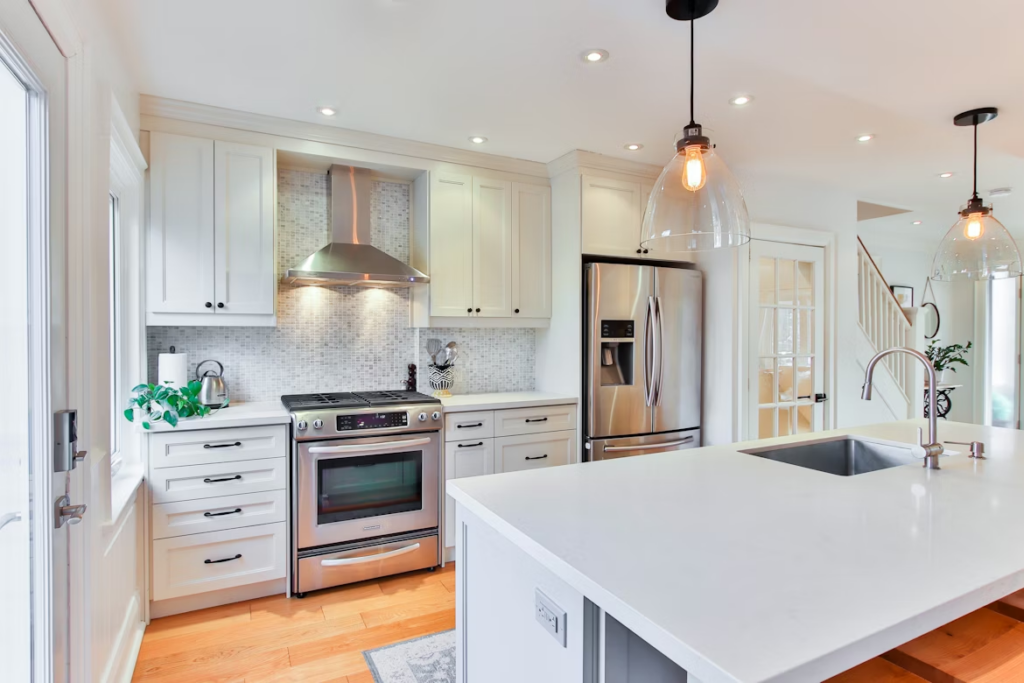
There’s a reason real estate brokers say the same thing at each open house: kitchens sell houses. And, although it sounds like something sewn into a pretty throw pillow, the stats back it up. A simple kitchen makeover recoups an average of 85.7% of its cost when resold. A bathroom extension, by contrast, costs approximately 54%. So the room where you brew your morning coffee is, quietly, the most financially burdened room in the home.
This is somewhat paradoxical since the most lucrative enhancements aren’t typically the most noticeable. It’s not always necessary to start from scratch and gut everything. You must understand which modifications are really registered.
The Psychology of Warm Materials
Most people know that “warm materials” are a good idea. What’s less obvious is why they work so reliably and what exactly qualifies. Design researchers use the term material empathy to describe the way humans respond emotionally to surfaces that echo natural environments. Warmth isn’t just a color temperature. It’s texture, weight, the sense that something was made rather than extruded.
Why Wood Deserves a Second Look
Wood, specifically, has been making a very convincing comeback – not the sticky laminate kind, but honest, structural wood used with some intention. Butcher block countertops, once associated almost exclusively with deli counters and renovation shows that haven’t aged well, have found a smarter second life in modern kitchens. Not as an all-over surface, but as a considered counterpoint: a butcher block run on the island set against stone perimeter counters, or a small inset section dedicated to prep work. The result is that layered, lived-in quality that staged homes spend thousands trying and mostly failing to fake.
There’s also a practical argument that often gets overlooked. Butcher block is one of the few countertop materials that actually improves with age, or at least can be sanded back and refinished when it picks up marks, stains, or the general evidence of real cooking. No quartz slab offers that. If anything, quartz chips at the edges and stays chipped. Stone, for its part, does something else entirely: it adds perceived permanence. Buyers subconsciously equate heavy, solid surfaces with quality.
Cabinet Colors and Hardware
This is where a lot of homeowners trip over themselves: chasing the trend rather than the enduring. Remember millennial gray? It was everywhere in 2017. Walk into a gray kitchen today and it feels vaguely like a dentist’s waiting room – competent, inoffensive, quietly depressing.
Two-tone cabinetry like a moody navy on the lowers with warm white or cream uppers has shown surprising durability in buyer response surveys. Sage green has proven itself. Warm white reads as fresh without announcing the year of installation. Shaker-style doors remain the safe baseline because they’ve been around since the 18th century. Hardware is the detail that punches well above its cost: brushed brass, unlacquered bronze, matte black. These finishes feel deliberate in a way that standard chrome just doesn’t anymore. Swapping hardware is also one of the cheapest upgrades available, which makes it almost embarrassingly good value.
The Island Question
Almost everybody wants a kitchen island. However, desiring one is not the same as really benefitting from one. A badly situated, small, or solely ornamental island is perhaps worse than no island at all, since it consumes square footage while doing nothing and obstructing everything. Kitchen islands are frequently ranked among the top five most-wanted amenities by homebuyers. The operative term, however, is functioning. Buyers have become very adept at strolling into a kitchen and determining if an island was built to be utilized or photographed.
The Details That Do the Quiet Work
Real estate professionals will tell you that buyers often struggle to explain why one kitchen felt better than another. What they’re almost always responding to is lighting. Layered lighting, specifically: ambient overhead, task lighting under cabinets, a pendant over the island. A kitchen that’s properly lit reads as larger, cleaner, and more expensive than the same space with a single overhead fixture and a few shadows – and dimmable recessed lighting, which costs almost nothing extra to spec correctly, makes the same room feel entirely different at 7am versus 7pm.
Countertops and backsplash form an impression within seconds of walking in; hardware and lighting do the rest for a fraction of the cost. As for appliances, stainless steel has genuinely lost its premium signal, partly because it’s everywhere, partly because it shows fingerprints with spectacular dedication. Integrated panel-ready appliances, where the fridge and dishwasher disappear into the cabinetry, are the kind of detail that makes buyers go quiet in a good way.
Summary
Ask almost any experienced designer what kitchen upgrades actually hold their value and the answer keeps circling back to the same principle: stop designing for the moment. The kitchens that feel genuinely valuable five years from now are the ones that feel considered rather than current – warm materials used with intention, a layout that rewards daily use, design that doesn’t try too hard to announce itself.
Understatement is perceived as a kind of luxury. And in a room that is more important than almost any other room in the house, this quiet thoughtfulness can be the most valuable improvement of all.
More Stories
7 Things to Check Before Making a Decision About a Property
7 Things to Know Before Starting a Career in Real Estate
7 Things to Look for When Choosing Technology for a Real Estate Agency
Artificial Plants for Modern Homes: How to Make Your House Look Natural Without Any Effort